
Summarise the information by selecting and reporting the main features, and make comparisons where relevant.
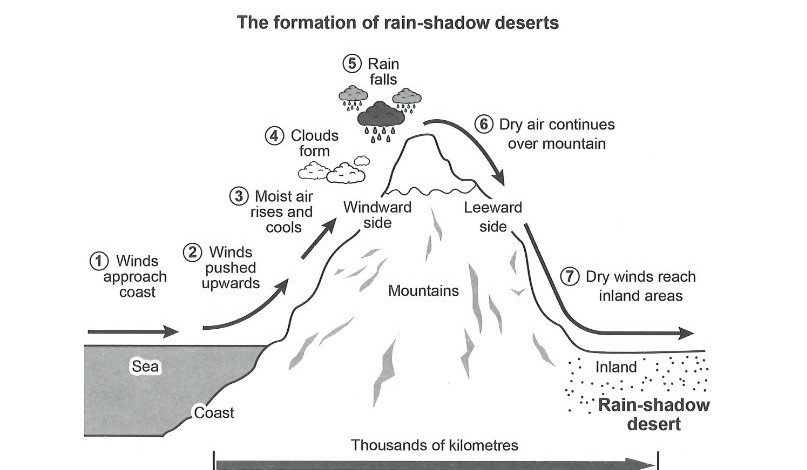
The diagram illustrates the process by which rain-shadow deserts are formed, showing how wind and geographical features interact to create dry conditions in certain inland areas.
Overall, the formation of a rain-shadow desert involves a sequence of stages, beginning with moist air from the coast and ending with dry winds reaching inland regions. The key factor is the presence of a mountain range that forces air to rise and lose its moisture.
Initially, moist winds approach the coast from the sea. As these winds encounter a mountain range, they are forced to rise upwards. As the air rises, it cools and condenses, forming clouds. This leads to precipitation, with rain falling on the windward side of the mountains. This is the stage where most of the moisture is released from the air.
After the rain has fallen, the remaining dry air continues to move over the mountain peak and down the other side. At this point, the air contains very little moisture. As this dry air descends and travels further inland, it creates arid conditions. These dry winds can travel thousands of kilometres, eventually forming a rain-shadow desert in the interior regions far from the coast.
In conclusion, the process demonstrates how mountains act as a barrier, causing rainfall on one side while creating dry conditions on the other, which ultimately leads to desert formation.
Why this answer scores Band 6.5:
| Criteria | How the sample meets Band 6.5 requirements |
|---|---|
| Task Achievement | Addresses all stages of the process in a logical order. Provides a clear overall description of how rain-shadow deserts form. |
| Coherence & Cohesion | Uses clear sequencing words (Initially, After this, At this point). Has a clear introduction, body, and conclusion. Logical flow from coast to inland. |
| Lexical Resource | Adequate vocabulary for the task (moist winds, encounter, forced to rise, condenses, precipitation, arid conditions, barrier). Some good topic-specific terms. |
| Grammatical Range & Accuracy | Uses a mix of simple and complex sentences. Present tense used correctly for describing processes. Minor grammatical issues but overall clear and understandable. |
What holds this answer back from Band 7.0:
| Issue | Why it limits the score |
|---|---|
| Vocabulary is a bit basic | Repeats dry, air, mountain too often. Could use more precise terms like leeward side, water vapour, condensation, precipitation, arid climate. |
| Lack of passive voice | Band 7+ process descriptions use passive structures (is forced, is released, is formed). This sample uses mostly active voice. |
| Conclusion is unnecessary | In Task 1, an overview is required, but a separate "in conclusion" paragraph is not needed for processes. Better to expand the body with more detail. |
| Limited comparison | The prompt asks to "make comparisons where relevant" – but this is a process diagram, so comparisons are less relevant. Still, you could contrast windward vs. leeward conditions more explicitly. |
| Some vague language | Phrases like "certain inland areas" and "this is the stage where" are imprecise and informal. |
How to improve this to Band 7.0+:
Weak version (6.5):
"As the air rises, it cools and condenses, forming clouds."
Stronger version (7.0+):
"As the warm, moisture-laden air is forced to ascend the mountain slope, it undergoes cooling, leading to condensation and subsequent cloud formation."
Key tips to reach Band 7.0 for process diagrams:
Use passive voice naturally
The air is forced upwards.
Moisture is released as precipitation.
Dry conditions are created on the leeward side.
Use process-specific vocabulary
Moisture-laden air, water vapour, condenses, precipitation, evaporation, arid, leeward side, windward side, barrier, descend, expand.
Sequence clearly
The process begins with... / This is followed by... / Subsequently... / The final stage involves...
Don't add a conclusion – For processes, just describe all stages clearly. The overview (second paragraph) is enough.
Be precise with location
Instead of "the other side of the mountain," say "the leeward slope" or "the sheltered side."
Improved version (Band 7.0 - for reference):
The diagram illustrates the sequential process by which rain-shadow deserts are formed, showing the relationship between coastal winds and mountain topography.
Overall, the formation involves a series of stages, beginning with moist air from the ocean and culminating in dry, arid conditions inland. The critical factor is the presence of a mountain range, which acts as a physical barrier to the movement of air.
Initially, moisture-laden winds approach the coast from the sea. Upon encountering a mountain range, these winds are forced to ascend. As the air rises to higher altitudes, it undergoes cooling, causing water vapour to condense and form clouds. Consequently, precipitation occurs, with rain falling heavily on the windward side of the mountains, where most of the moisture is released.
Subsequently, the now dry air continues its journey over the mountain peak and descends the opposite, or leeward, side. At this stage, the air contains very little humidity. As these dry winds travel thousands of kilometres inland, they create extremely arid conditions, ultimately resulting in the formation of a rain-shadow desert in the interior.
Quick comparison: 6.5 vs 7.0+
| Aspect | Band 6.5 | Band 7.0+ |
|---|---|---|
| Vocabulary | dry, air, mountain (repeated) | moisture-laden, leeward, windward, precipitation, condensation |
| Grammar | Mostly active voice | Passive voice used naturally |
| Precision | "other side of mountain" | "the leeward slope" |
| Sequencing | Basic (Initially, After) | More varied (Upon encountering, Subsequently, Consequently) |
| Overview | States what happens | Explains why it happens (mountains act as a barrier) |
Band Score 6The diagram illustrates the process by which the rain-shadow deserts formed. Overall, the process takes a thousands of kilometers and consists of 7 steps, beginning with winds becoming closer with coast and ending with dry winds reaching inland areas. Moving to the details, at the first stage, winds from the sea approach coast. Same winds travel upwards, to the top of the mountains. On their way, water from seas evaporate and become moist. This moist air cools and eventually turns into clouds. On the fifth step, formed clouds fill up with water and then rain falls on the peak of the mountains. Dry air then goes along leeward side of the mountain. Those winds continue going down the hill until they finally reach inland areas.