
You should spend about 20 minutes on this task. Write at least 150 words.
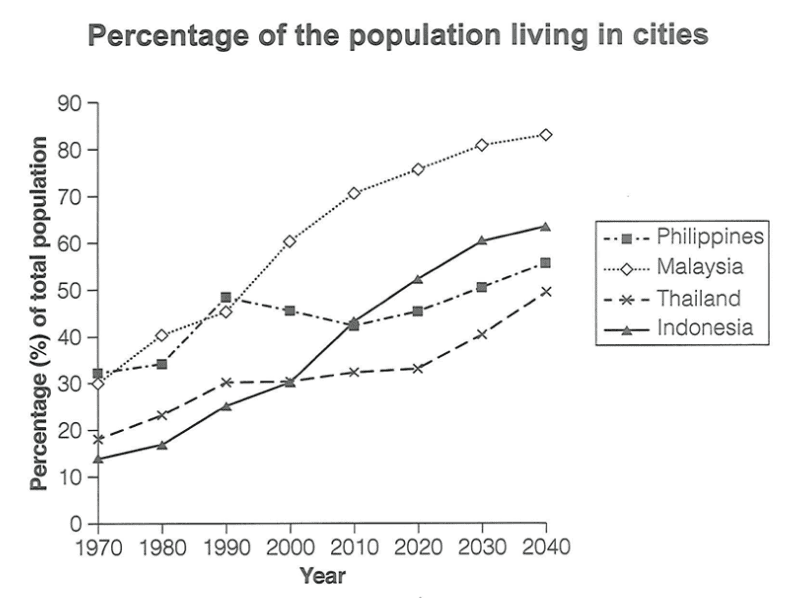
The graph below gives information about the percentage of the population in four Asian countries living in cities from 1970 to 2020, with predictions for 2030 and 2040.
Summarise the information by selecting and reporting the main features, and make comparisons where relevant.
Summarise the information by selecting and reporting the main features, and make comparisons where relevant.
The line graph illustrates the percentage of urban dwellers in four Asian countries—the Philippines, Malaysia, Thailand, and Indonesia—between 1970 and 2020, with projections for 2030 and 2040.
Overall, all four countries experienced a steady increase in urbanisation over the five-decade period, and this upward trend is expected to continue into the future. Malaysia consistently had the highest proportion of city dwellers throughout the period, while Indonesia remained the lowest until it overtook Thailand in the later years.
In 1970, Malaysia had the highest urban population at 30%, followed by the Philippines at 28%, Thailand at 13%, and Indonesia at 12%. Over the next 20 years, all countries saw gradual growth, with Malaysia reaching 48% by 1990, while the Philippines and Thailand rose to 49% and 26% respectively. Indonesia, though still the lowest, increased to 28% by 1990.
From 1990 onwards, urbanisation accelerated in most countries. By 2020, Malaysia had climbed to 77%, becoming the most urbanised nation, while the Philippines followed closely at 48%. Indonesia overtook Thailand in 2010, with figures of 32% and 31% respectively, and by 2020, Indonesia had reached 38%, surpassing Thailand's 34%.
Looking ahead, the trend is projected to continue, with all four countries expected to see further increases by 2040. Malaysia is forecast to reach 82%, while the Philippines, Thailand, and Indonesia are predicted to rise to 56%, 50%, and 45% respectively. Despite the growth, Malaysia is expected to maintain its position as the most urbanised nation, while Indonesia will likely remain the least urbanised.
In conclusion, urbanisation has risen significantly across all four countries and is set to continue, with Malaysia leading the trend and Indonesia gradually closing the gap.
Band Score 5The proporation of the population is provided information by the line graph in four countries - Philippines, Malaysia, Thailand and Indonesia - living in urban area between 1970 to 2020. It also has been predicted for 2030 and 2040. In general, Malaysia and Indonesia were shown up-ward trend throught the period, while other two were displayed flactuation. To begin with, Malaysia was started from 30 in 1970, after that, it was grew significantly and reached over 80 in 2040, whereas Philippines also started near the same point , however , by 1990 it was peaked at 50 , next had been showed down-ward trend , which was 40 and at last it was stopped at over 50 in 2040. In 1970, Indonesia was started at 12 and go up constantely to 2040 and touched the point of 60, while Thailand was started from 19 in 1990 , increased steadely to 30 by 1990 , after that remain stable to 2020 , and last , it had been preasented rapid growth to 2040 , when it was reached at 45.
Band Score 4.5The given figure illustrates the difference between the percentage of population in four asian countries in certain city from consuctive years 1970 to 2020 with predction for 2030 and 2040. Overall, the population of malaysia and indonesia is growing rapidly feom 1970 to 2040 .While , philippines and thailand population grows constantly with not much pressurely. malaysia becomes most populated in all countries . thailand becomes lowest one . The population of malaysia was 30% in year 1970 and can grows rapidly to 85% approximately in 2040 . While in case of philippines , the population will not grow much rapidly as it was 30% in 1970 to 50% in 2040. While, indonesia population also grows upto 12% approximately in 1970 to 60% in 2040 . in case of thailand's population , it becomes 19% approximately in 1970 to 45% approximately in 2040 .
Band Score 6.5The line graph illustrates the urban population in four countries in Asia in terms of relative percentage over the span of 1970 to 2020, with forecast figures in 2030 and 2040. In general, it can be observed that urban population in the four nations all experienced a marked growth. Among them, Malaysia witnessed the most substantial expansion, while city in Thailand remained the least populated. In 1970, Philippines recorded the largest city population, accounting for just above 30% of total population. Malaysia followed closely, standing at approximately 30%. In contrast, Thailand and Malaysia registered the least urban population, between 10% and 20%. In the ensuing years, all four countries underwent a marked growth in urban population. As Malaysia rose to become the top, Indonesia, which is previously the least, surpassed both Philippines and Thailand to become the second most populated. This trend is anticipated to continue up to 2040, with Malaysia peaking at roughly 80%, followed by Indonesia clocking in at around 60%.
Band Score 6The line graph illustrates the proportion of citizens from four Asian countries living in urban cities from 1970 to 2020 and predicts the population growth for 2030 and 2040. Overall, it can be seen that Malaysia and and Indonesia had the majority of population living in the cities. Thailand and Philippines also shows an upward trend. Malaysia's population growth rate in the cities rose from 30% in 1970 and followed an upward trend till the year 2020 with 75% population living in the cities. On the other hand, even though Indonesian population started from mere 14%, its numbers rose dramatically surpassing Philippines and Thailand to over 50% in 2020. It is estimated that 80% of the Malaysians and over 60% of Indonesians will move to cities in next two decades. Philippines population percentage living in the cities was more then all three countries, 32% in 1970 and little under half in1990. From that point onwards its population percentage in urban cities fluctuated and stood at 45%.Thailand's populace living in cities increased from 18% to just over 30% in 2020. It is predicted that both Philippines and Thailand's population percentage in urban cities will sea a slight rose in years 2030 and 2040.
Band Score 5The picture illustrates the growth of residents in four Asian countries over the past half century since 1970 and the estimation number in the two decades after. In general, the total population in all countries is expected to increase over time. Indonesia and Malaysia have similar pattern. The picture illustrates the growth of residents in four Asian countries over the past half century since 1970 and the estimation number in the two decades after. In general, the total population in all countries is expected to increase over time. Indonesia and Malaysia have similar pattern. The picture illustrates the growth of residents in four Asian countries over the past half century since 1970 and the estimation number in the two decades after. In general, the total population in all countries is expected to increase over time. Indonesia and Malaysia have similar pattern.
Band Score 5.5The line graph illustrates the portion of inhabitants in urban areas between 1970 and 2040. Overall, the percentage of population living in Malaysia and Indonesia is being increased consistently while Philippines and Thailand is being fluctuated but showed an overall increase. The figures for Malaysia and Indonesia are being boomed over this period, although the former started with second place, it overtook the other figures and become a dominant during this period. The latter was started with only under 15% of the total population, after decades it crossed two countries from 2000 to 2010 and ranked second place. In future, Indonesia planning to reach 60% of total inhabitants. Other two countries which are Philippines and Thailand gradually rised, the first one was a dominant at 1970. The second one was also third place and saw a slowly rise over this period, although their percentage increased, it fell behind in terms of ranking.
Band Score 5.5The line graph illustrates the proportion of total population living in the urbans of four different Asian nations from 1970 to 2020, followed by the predictions for 2030 and 2040. At a glance, it is clear that Phillippines will account for highest number of urban people in future. Overall, it is evident that the figure of all the mentioned country will witness a growth by 2040. Among them, Thailand will represent the lowest number of people city percentages while the proportion of urban population of Indonesia will be second. Altogether, in 1970, the population percentage of Malaysia and Indonesia was 30% and 14%, respectively. Then, the urban population of Malaysia and indonesia will soar by 2040, at 80% and 60%, respectively. The number of city people decreased to 42% in 2010, followed by an increase to 48% in 1990. However, the predicted urban population will steadily go to 50% in 2040. Thailand witnessed a climb till 2020 at 28%, and in 2040, the population will increase by 10%.
Band Score 6.5The line graph illustrates the proportion of people from four different countries (Philippines, Malaysia, Thailand, and Indonesia) who were living in cities between 1970 and 2020, and it also provides predictions for people who will be living in cities in 2030 and 2040. Overall, it can be seen that people from all countries are expected to rise in the future. Indonesia accounts for the smallest proportion of people who were lived in cities, while this figure is forecasted to exceed that of Philippines and Thailand. In addition, the majority of people in Malayasia lived in cities compared with other counties, and this figure is expected to remain higher in the future. In 1970, approximately 15% of people in Indonesia and almost double that in Malaysia (30%) lived in cities, whereas these proportions increased dramatically in both countries throughout the years, and are expected to stand around 60% in Indonesia and peak at about 80% in Malaysia in 2040. In Thailand, nearly 20% of people lived in cities in the initial year, which is predicted to reach about 40% in 2040, while this figure remains the lowest in the future. The population of Philippines who lived in cities represented a different pattern, began at about 30%, then increased to around 50% before declining to 40% in 2010. From this point, the percentage is expected to rise up to 50% in the future.
Band Score 5.5The given line graph illustrates percentage of the population living in four different Asian countries' cities between 1970 and 2020, also it gives predicts for 2030 and 2040. First of all, all countries' population living in cities increased steadily in 2020, when it compared to starting point. Also, their population will be able to increase in the future is considered. When we look at the details, Malaysia's percantage of population rocketed especially after 1990, and it reached about 75% of total population, constant rising. While density of people living in cities in Indonesia was last one at the beginning of the period, this value reached second one in 2020, passing Philippines' and Thailand's population. On the other hand, even if Philippines' value passed Malaysia's population in about 1985, Malaysia protected the first grade throughout all period. However, in 2000, while Thailand's population increased slowly, Indonesia's population passed it, growing dramatically.
Band Score 5.5The line graph illustrates percentage of the population living in four cities. the percentage shows population in different cities mostly far in every year. the trends shows highest percentage of population in Philippines and Malaysia from 1970 to 2040. Additionally, Malaysia and Philippines shows the highest percentage of population as a compared of Thailand and Indonesia. from 1970 to 2040 population of Philippines and Malaysia increasing widely. and the others remains same year. in contract, Thailand and Indonesia between 15 and 19 percentage of the population from 1970 to 2040 which leads moderate percent of population than Philippines and Malaysia. the total percentage of four cities population that reminds and increasing flow of people as a compare of villages.
Band Score 5.5The line chart depicts the waitage of the population in four different Asian countries residing in cities between 1970 and 2020 with prediction for 2030 and 2040.Overall,we have seen malaysian people living in cities and rapidly could increases in the future whereas, we could see the few people of thailand would like to live in cities. The percentage of population of malaysian live in cities steady increase by the time from 1970 to 1990 then we have seen that from 1990 to 2040 the population of malaysia would be more likely to go to cities for residence.There is gradual increases in philippines people forward to cities from 30% to 49% nevertheless after 1990 to 2040 we would be see lower percentage of philippines population live in cities. Furthermore,in case of indonesian resident population were at lower rate about 12% people was interested to live in cities during the period 1970 to 2000 a steady increase we have seen but after 2000 to 2040 we would see a dramatic increase in indonesian people will be more like to live in cities in future.The people of thailand live in cities was gradually increase from 1970 to 1990 about 20% to 30% then we have seen the people's migration rate to cities was stabalized from 1990 to 2010 then they gradualy increase but at very lower rate about rate of 31% to 40% approx.
Band Score 6The line graph illustrates the information about the proportion of the population in four Asian countries living in cities from the year 1970 to 2020. Next, this figure will predict for 2030 and 2040. Overall, the population in four countries increased steadily until 2040. The proportion of people in Malaysia hit the highest point. However, the percentage of people living in Philippines had the clearly different. Firstly, the percentage of people living in Malaysia accounted for the highest, people in Indonesia was the second. In 1970, the figure of people in Malaysia take up 30% and then increased slightly to nearly 80% in 2020. The prediction for 2030 and 2040 is approximately 80% to 85%. The proportion of the population living in Indonesia is similarly, which was increased continuously. The rate of this cities was below 20% in 1970 and this figure increased sharply to about 50% in 2020, with predictions for 2030 and 2040 is nearly 60%. Secondly, the population in Philippines and Thailand had the different than two countries before. The percentage of people in Thailand increased gradually from nearly 20% by 1970 to 30% by 2020. In the future, this city predicts the figure increased rapidly, got to 35% by 2030 and nearly 50% in 2040. However, the Philippines had the irregular fluctuation. In 1970, the rate of people only about more than 30% and then increased quickly to 50% by 1990. However, it declined to 40% by 2010 and remained it until 2020. In the future, the prediction for 2030 and 2040 is approximately 45% to 50%.
Band Score 6The line graph depicts the percentage of people who lived in cities from 1970 to 2020, with the expectation for 2030 and 2040 in four Asian countries. Overall, it can be seen that the percentage of people who live in cities in Malaysia followed a steady rise trend, whereas others show a fluctuating trend. In 1970, the percentage of the population living in cities in Malaysia and the Philippines was around 30% , whereas Thailand and Indonesia had almost 18% and 15% respectively. This trend in Malaysia continued to grow till 2020, at around 73%, which was expected to increase to 82% in 2040. However, the percentage of people who live in the Philippines cities experience fluctuated trend till 2010, then it rose steadily to almost half of the population in 2020 and is predicted to reach at 55% in 2040. By 2000, the percentage of population living in cities in Thailand and Malaysia was same, but Thailand will become the second highest in 2040, and Indonesia will become the lowest among four countries
Band Score 6The graph illustrates the proportion of the population living in four different countries, namely the Philippines, Malaysia, Thailand, and Indonesia, during the period of 1970 to 2020 and expectations for the years 2020 and 2040. Overall, there was a increase in the population of Malaysia and Indonesia over the whole period. While the Philippines and Thailand demonstrated a significant decrease in the middle years, they are predicted to rise over the upcoming years. In the year 1970, Malaysia and the Philippines had similar percentages of population accounted for, about 30%. Moving further, the trend rose significantly in Malaysia and became the highest populated city in 2020 with about 70% of the population and is predicted to follow the constant rising trend at the end of the year 2040 by 80%. However, the Philippines showed a substantial decline in population in 2010 by 40% and is expected to rise in 2040 by 50%. At the beginning of the years, the population of Thailand rose to about 25%, and then it became constant over the years from 1990 to 2020 and increased about 45% in 2040. Whilst, Indonesia was the city that showed a greater rise in population over the whole years and will reach up to 60% of the population in the end of the period.
Band Score 5.5The graph shows the percentage of the population living in cities in Philippines, Malaysia, Thailand and Indonesia from 1970 to 2020. In general, Every country has moved forwad every year meanwhile there is one of the country named Philippines goes down in 2000. Indonesia becomed the lowest percentage in 1970 than all of the four country. The percentage of population in Indonesia growed up gradually every year and reached about 60% in 2040. Thailand growed very slowly compared with others and reached 45% in 2040. Malaysia in the other hand was the highest percentage of population that reached 80% in 2040. It also growed straighly every year. it growed up straighly in 2000 with 60% population from 45% in 2000.
Band Score 6The graph shows city living going up in the Philippines Malaysia Thailand and Indonesia from 1970 onwards with some future numbers too. Overall, Malaysia has the biggest share most years and that looks set to keep going. Thailand stays lowest for a long time. Indonesia has the biggest jumps especially later on. In 1970 the Philippines was at 32 percent and Malaysia just under that at 30. Thailand and Indonesia started much lower around 18 and 13. By 1990 things had changed with the Philippines reaching almost 50 percent. Malaysia overtook later on. It went from 60 percent in 2000 up to 76 in 2020 and it seems it will get to 83 by 2040. The Philippines fell to 43 then rose a little. Indonesia grew a lot to 53 percent by 2020 and probably 64 later. Thailand was slower reaching 33 then heading to 50.