
Summarize the information by selecting and reporting the main features, and make comparisons where relevant.
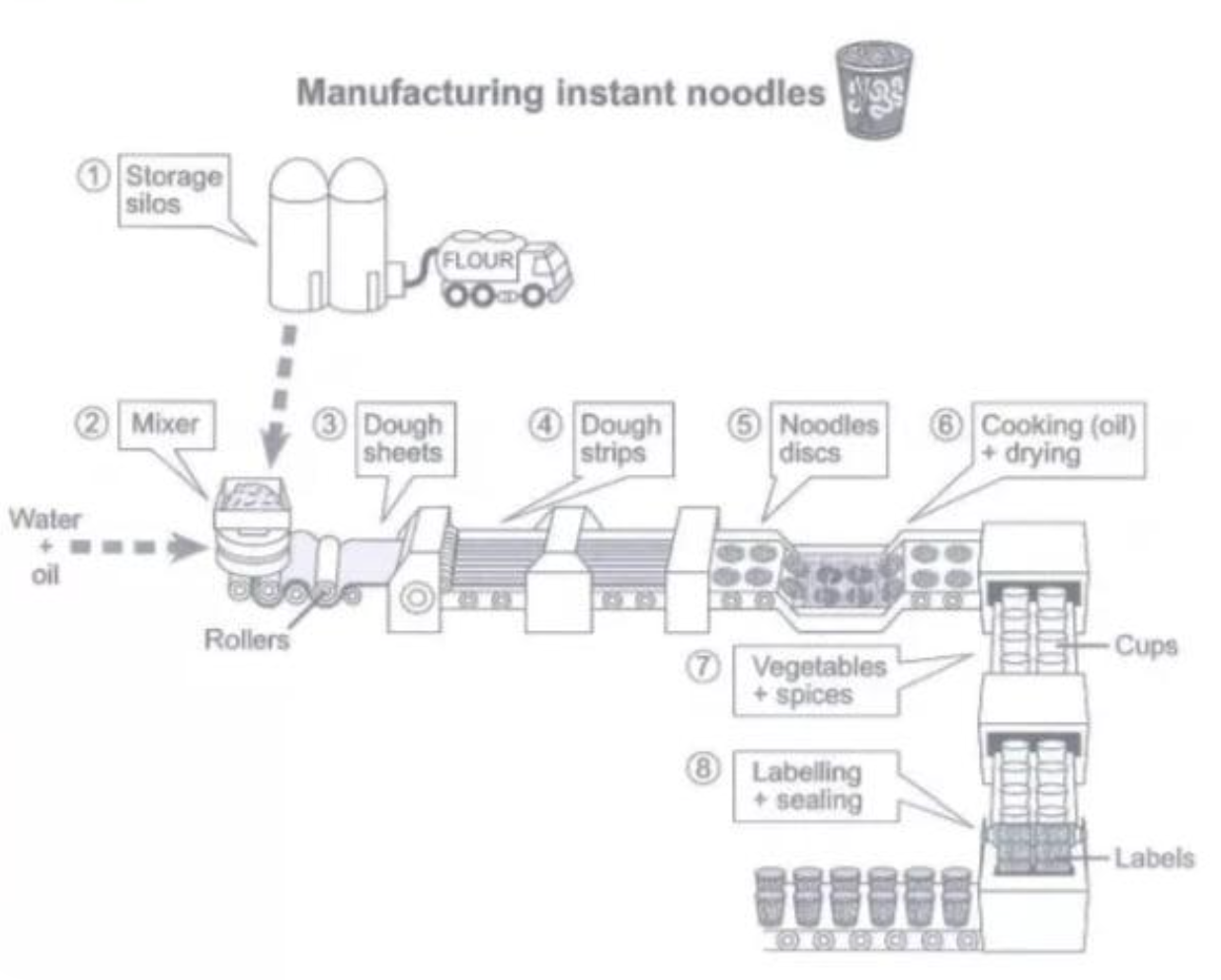
The diagram illustrates the sequential process involved in the industrial production of instant noodles, encompassing nine distinct stages from the initial storage of raw ingredients to the final packaging of the finished product.
Overall, the manufacturing process is a linear one, comprising three main phases: preparation of the dough, shaping and cooking the noodles, and finally, packaging them with accompanying flavourings. The procedure is largely mechanised, with human intervention occurring primarily at the quality control and packaging stages.
The process commences with the storage of flour in large silos, from which it is subsequently transferred to a mixer where water and oil are added to form a homogeneous dough. This dough is then passed through rollers to produce continuous dough sheets, which are subsequently cut into long, thin strips. These strips are then shaped into circular noodle discs, which are the iconic form associated with instant noodles.
Once the noodles have been shaped, they undergo a crucial cooking phase, during which they are first flash-fried in oil and then thoroughly dried. This step is essential as it removes moisture, thereby extending the product's shelf life. Following this, the dried noodle discs are placed into polystyrene cups, accompanied by sachets containing dehydrated vegetables and a selection of spices, which are added to enhance the flavour profile.
The final stages of the process involve labelling and sealing the cups. Each cup is fitted with a label, and the entire unit is then sealed with a protective lid to ensure freshness and prevent contamination. The finished products are then ready for distribution to retailers.
Why this answer scores Band 8.0:
| Criteria | How the sample meets Band 8.0 requirements |
|---|---|
| Task Achievement | Fully describes all nine stages of the process in logical sequence. Provides a clear overview and identifies the three main phases. Accurately reports all key features without omitting any stages. |
| Coherence & Cohesion | Exemplary paragraph structure with sophisticated organisation. Uses a wide range of cohesive devices naturally: Overall, from which, subsequently, once, during which, following this, to ensure. Seamless flow from introduction to conclusion. |
| Lexical Resource | Extensive and precise vocabulary: sequential process, industrial production, encompassing, linear, mechanised, intervention, commences, transferred, homogeneous, rollers, iconic, undergoes, flash-fried, thoroughly dried, shelf life, sachets, dehydrated, flavour profile, distribution. |
| Grammatical Range & Accuracy | Wide range of complex structures used with complete control. Includes: relative clauses (from which it is subsequently transferred), participle phrases (accompanied by sachets containing...), passive voice throughout, and sophisticated time expressions (once the noodles have been shaped). Virtually no errors. |
What pushes this to Band 8.0 (compared to Band 7.5):
| Aspect | Band 7.5 | Band 8.0 (this sample) |
|---|---|---|
| Vocabulary | Good range with precision | Extensive with sophisticated technical terms (homogeneous, iconic, flash-fried, shelf life, sachets, dehydrated, flavour profile) |
| Passive voice | Used correctly | Used consistently and naturally throughout (is transferred, are shaped, are added, are fitted) |
| Process explanation | Describes steps clearly | Explains why steps are important ("This step is essential as it removes moisture, thereby extending the product's shelf life") |
| Grammar | Complex structures | Full range with complete control |
| Cohesion | Good | Seamless and sophisticated |
Key features of Band 8.0+ process diagram writing:
1. Consistent use of passive voice (essential for processes):
| Active (less formal) | Passive (more formal - Band 8+) |
|---|---|
| Workers store flour in silos. | Flour is stored in large silos. |
| They add water and oil. | Water and oil are added. |
| Machines shape the strips. | The strips are then shaped. |
2. Sophisticated sequencing language:
The process commences with...
...from which it is subsequently transferred...
Once the noodles have been shaped...
Following this...
The final stages involve...
3. Explanation of purpose:
"This step is essential as it removes moisture, thereby extending the product's shelf life."
(Band 8.0+ doesn't just describe; it explains why each step matters.)
4. Precise, technical vocabulary:
homogeneous dough (instead of just "mixed")
flash-fried (specific cooking method)
sachets (specific packaging term)
dehydrated vegetables (precise term)
flavour profile (industry terminology)
5. Logical grouping of stages:
The essay groups the nine stages into three logical phases:
Preparation (stages 1-2)
Shaping and cooking (stages 3-6)
Packaging (stages 7-9)
Quick checklist for Band 8.0+ Task 1 (Process Diagram):
Clear introduction paraphrasing the task
Overview paragraph identifying main phases
Passive voice used consistently throughout
Wide range of precise vocabulary
Sophisticated sequencing language
Explanation of purpose for key steps
Logical grouping of stages (not just listing)
Full range of complex grammatical structures
Virtually no errors
At least 170-190 words
Comparison: Band 6.5 vs 7.5 vs 8.0 (same task)
| Aspect | Band 6.5 | Band 7.5 | Band 8.0 (this sample) |
|---|---|---|---|
| Introduction | "The diagram shows how instant noodles are made." | "The diagram illustrates the process of manufacturing instant noodles." | "The diagram illustrates the sequential process involved in the industrial production of instant noodles, encompassing nine distinct stages..." |
| Passive voice | Some use | Good use | Consistent and natural throughout |
| Vocabulary | flour, water, oil, cut, cook | stored, transferred, shaped, fried | sequential, homogenous, iconic, flash-fried, thoroughly dried, shelf life, sachets, dehydrated, flavour profile |
| Explanation | Describes steps only | Describes with some explanation | Explains purpose ("...thereby extending the product's shelf life") |
| Grammar | Simple sentences | Good variety | Full range, complete control |
| Cohesion | Basic links (first, then, next) | Good range | Sophisticated and seamless |
Additional tips for Band 8.0+ in process diagrams:
Use a range of passive structures:
Present simple passive: is transferred, are shaped
Present perfect passive: have been shaped, have undergone
Modal passive: are then fitted, are ready for distribution
Include purpose/function:
"This step is essential as it..."
"...in order to ensure freshness..."
"...thereby extending the product's shelf life."
Vary sentence openings:
"The process commences with..."
"Once the noodles have been shaped..."
"Following this..."
"The final stages involve..."
Avoid personal references:
Do not use you, we, I in process descriptions.
Use technical terms where appropriate:
If the diagram labels a specific term (e.g., silos, rollers, sachets), use it correctly.
Band Score 6The process diagram illustrates the stages involved in instant noodle production from flour storage to the final packaging stage. Overall, the instant noodle manufacturing process begins with flour being taken from storage silos and mixed with water and oil, and ends with labelled and sealed instant noodle cups. During the process, noodles are processed, shaped, cooked, dried, and mixed with vegetables and spices before packaging. In the initial stages, flour is taken from storage silos and transfered in mixture, where the water and oil are added. Then the mixture goes through the rollers and is shaped into noodle discs. In the remaining stages, the noodle discs are cooked in oil and subsequently dried. Then the vegetables and spices are added to the noodle cups. At the end of the stage, the noodle cups are labelled and sealed.
Band Score 6The diagram depicts that how instant noodles are manufactured.By a cursory glance it is crystal clear that there are 8 steps involved in the manufacturing of instant noodles.Primarly, flour is transferred to storage silos from a vehicle through a pipe. Furthermore the flour is mixed with water and oil in a mixer . Afterwards , dough sheets are prepared from the mixture followed by dough strips. Moreover, the dough strips made in the previous step pass through noodle discs and form the shape as we see them in. Upon further scrotinizing it was evident that cooking oil was added to the noodles and then these were dried . Followed by addition of vegetables and spices in cups. In the last leg labels are added to the noodles and they are sealed for final consumption.
Band Score 5.5The following diagram step by step that how floor is connected from every corner and is supplied to process, after passing through 8 different steps then noodles are finally packed up. Overall, this process is started by putting large quatity of flour in storage silos and ended up by making labelling and sealing products. At first, flour is filled in the storage silos through the tube. In second stage, these substances mixed with adding water and oil with a mixer and after that goes through rollers. In third stage, the whole substance is going through dough sheet and then goes through dough strips are molded to noodles disc. In sixth stage, adding some cooking oil, drying process is started. As noodles disc got dried, these are packed in the cup along with vegtables and spices. The last step is putting labeling on the cups and sealing them. Finally, instant noodles are ready to sell in the market. In conclusion, this is how noodles are manufactured before selling them in market.
Band Score 5.5The given diagram illustrates how instant noodles are manufactured.This process is manufactured by 8 stages. Overall, this process began with storage silos filled by flour and ended up with labelling and sealing products. At the first, in the first stage flour is collecting from different flours sites by large truck in the silos through a tube.Then in stage two, this substance mixed with water and oil with a mixer and after that goes through rollers.Following the step, these substance passes by dough sheets.After that, it goes by dough strips and noodles discs in the fourth and fifth step.Following this, the whole substance blends with cooking oil and then it goes to drying process.After drying, in the seventh step, the resulted mixture get divided with cups and during this process vegetable and spices are added.In the last eighth step, the processed food packed and sealed with labels. In conclusion, this process are manufactured for instant noodles before packaging and labelling process than transport to market for selling and consumer uses.
Band Score 6The diagram illustrates that how instant noodles are manufactured. there are several steps describe in diagrams which are involved in manufacturing of instant noodles starting from storage of flour in silos and ending with labelling and sealing of the final product. First flour is stored in large silos . it is then mixed with water and oil to from dough . the dough is rolled into dough sheets and then cut into strips.in next step the dough strips are shaped into noodles discs and next it is cook in oil . after cooking noodles discs are dried and placed into cups section where vegetables and spices are added into noodles and at the final step cups are labeled in the factory and also cups are sealing in the factory which is the final and last step instant noodles manufacturing. This is the whole process of manufacturing of instant noodles which include eight steps
Band Score 4.5The diagram shows how instant noodles are manufactured. overall the process making instant noodles in 8 stages. First of all in the first stage the flour put in the storage soil. ithen stage in two mix water and oil with mixer container and produce in roller foam. in the three stage the roller passes in dough sheet. then in four stage dough passes through in dough strips. in the five stage the dough strips molded in noodle dics. in the six stage cooking oil dded then start dry process. then in seventh stage noodles are dry then add vegetables and spices added. last stage noodles are packed and sealed.
Band Score 5.5The given diagram illustrates that how instant noodles are manufactured.The process is totally automated and processed through various machines. The diagram explains every step that how it is produced and and labeled lastly. The manufacturing process includes eight stages in total. Each is clearly defined in the diagram.At first, the storage silos are filled with flour which is carried in a container. At the second phase it is transferred to a mixer in which it is processed with water and oil. Followingly, it is then converted into dough sheets by passing through the rollers. Later it is cutted into the dough strips.Then after that the noodles discs are created. Then the noodles discs are cooked in oil and then drying them in the same step. Suprisingly the vegetable and spices are added to the cups of noodles.Finally the noodles are now ready to get labled and sealed and ready to sale.
Band Score 6The illustration depicts instant noodles manufacturing process. Overall, making instant noodles is an 8 step linear process. The process starts from preserving flours in silos and finishes with labeling alongside sealng the products. First of all, in the first stage a flour containing truck stores flour in the silos through a tube. Then in stage two, These substances mixed with water and oil with a mixer and after that goes through rollers. Following that, in step three the whole resulted substance passes by dough sheets. After that, it goes by dough strips and noodles disks in the fourth and fifth step respectively. Following that in the sixth stage, the whole outcome blends with cooking oil and then it goes through drying process. After drying, in the seventh step, the resulted output get divided with cups and during that process vegetables and spices are added. Finally, in the eighth step, the processed food get packaged and sealed.
Band Score 6.5The following diagram illustrates step by step that how floor is collected from every corner and is supplied to process, after passing through 8 different stages, noodles are finally packed up and are ready to supply to market for selling Firstly, flour is collected from different source sites by large trucks, and supplied to big storage silos on process site. After that specific quantity of flour is mixed with water and oil to make a dough in the mixer. Thirdly, the dough is passes between rollers to transformed it into dough sheets, and these are changed to dough strips.At fifth step dough strips are molded to noodles disc, and after adding cooking oil, drying process is start. As noodles disc got dried, these are packed in a cup along with vegetables and spices.The end stage is putting labellings on the cups and sealing them. Finally instant noodles are ready to sell in the market.
Band Score 5.5The diagram illustrates the process of instant noodle manufecting through various stages. Overall, it can be seen that the whole operation is carried out in eight squential stages of mixing the dough, cooking and packaging. In the first stage the flour is transported in rollers, mixed with oil and water to make dough. The dough sheets reach the next stage via rollers, and gets cut into dough strips. In the next step these strips are turned into the traditional noodles discs. After the process of cooking and drying these sheets reached to the next stage, ready to be packaged. Pre-mix vegetable and spice seasoning packets are packed inside cups with the noodles. Stacked on the conveyor belts, these cups move towards the next stage. In this last stage, the instant noodle cups gets sealed and move onto to be labelled.
Band Score 6The given process chart above illustrates the subsequential instant noodles manufacturing process, which encompassing nine crucial stages before get the final product. Overall, manufacture process is a linear one which follows each stage accordingly. The process commence with pouring fresh flour into storage silos which send the storage flour to mixer. In the mixer flour thoroughly mix well with water and appropriate amount of oil in order to get dough which make a perfect dough overtime with automated circular motions in the mixer machine. This mixer next go through thick multiple rollers to form dough sheets neatly and then machine automatically cut the dough sheets into equal sizes of dough strips. Next, these dough strips send to noodles discs which make straight sheets into required noodle shape while mixing well with cooking oil and then completely dried the noodles discs to make sure it absorbed all moisture or any wet texture. After complete drying process, this mixture collect to insulated thick noodles cups and then mix dry vegetables and spices according to required flavour and spicy level. At the end of the process cups are labelling according to the flavour and spices used initially and the sealing appropriately before contribute to the customers or retailers.
Band Score 6.5The diagram above displays the entire process of manufacturing instant noodles in large quantities. The process is entirely automated with no human intervention required anywhere. Overall, the linear procedure is comprised of eight substages, which can be evenly distributed into three main processes. First is the flour preparation stages then the flour is mixed and transformed into thick sheets and eventually scatterd into each individual cups manufactured in the third stage. At the start of the manufacturing process, flour is deposited into two large storage silos, then transferred into a large-scale industrial mixer, in which oil and water is added, after the mixing process, the resulting dough is then cut into seperate rolls and awaits further processing. Moving on to the second main stage, the dough sheets from the first stage is cut into thin strips and transformed into standard-size noodle discs which consumers are familiar with. The discs is then cooked in large batches and dried. After the two main stages above, the noodle discs is distributed into cups, this process is conducted entirely by machines, then vegetables and spices are added. Eventually, the cup is sealed and labelled, concluding the whole procedure of instant noodle manufacturing.
Band Score 6.5The diagram shows a step by step process of making instant noodles from flour. The process has eight total steps and follows a lineare structure mostly taking place on a conveyerbel and thus is a continious process. When looking at the start of the process the flour is storaged in silos after it is brought by truck delivery. After storage the flour is placed in a funnel which leads to a mixer, in the mixer it is mixed with water and oil. Out of the mixer comes a sheet of dough on top of a roller which stretches the dough out until it is thin enough. The stretched out dough proceeds to the dough strippers where long strips of dough are made. The strips are formed in to discs which are compressed. The discs are going through a pool of cooking oil which cooks the discs, after cooking the discs are dried. The cooked and dried noodle discs are placed in cups and topped off with vegetables and spices. The only thing left is labelling and sealing of the cups and after that the prodcut is ready for shipment.
Band Score 6.5The diagram given is detailed step by step process of how instand noodles are made. The first step in the diagram is extracting the flour out of the truck in to the storage silos. After that the flour is put in a mixing tube with water and oil and then gets mixed until there is a homogenous dough Out of the mixer comes a sheet of dough that gets rolled on to a convayerbelt. The convayerbelt moves the unfinished product along the process and machines until it is ready to be send to the stores. On the convayerbelt the doughs are striped in to slong trips. The long strips are then made in to a noodle disc. The noodle discs are cooked in oil while moving and then dried. After the cooking process the discs are put in to a cup and the cups are filled with vegetables and spices and then the cups are labeld and sealed.
Band Score 5This diagram shows the process of manufacturing instant noodles . we can see the tools that use for manufacture instant noodles . Overall , there is a whole process of manufacture process like; storage silos , mixing ,dough sheets , dough strips noodles discs , cooking & drying ,cups ,vegetables & spices , labeling& sealing . Now , the ,main topic is the process of making instant noodles and sealing them to let the customers enjoy . first of all we need flour ,after taking enough flour another process is to mix water , oil and flour to make perfect dough . Now ,let the dough sheets to be dough strips after that we need to discs noodles and then let them cooked and dried . Then , let them in the cups after that add some vegetables & spices for extra taste . Finally we are in the last stage of manufacturing instant noodles now ,labeling & sealing the cup noodles then, stamp the labels .Our tasty, delicious , instant noodle is ready to eat !! After all , this all process shows the whole process of manufacturing noodles . if we have the little patience we can make it easily .
Band Score 6The diagram illustrates the sequential process to prepare instant noodles. Overall, it can be seen that manufacturing process involves eight steps, which begins with flour being converted into noodles before being sealed in cups. In the first step, the flour is transported to storage silos by trucks, Then the flour is mixed with water and oil in a mixer before being passed it into rollers. In the next step, rollers converted the mixture into dough sheets. Then, dough sheets are converted into noodles discs by using sough strips. Finally, noodles are prepared which need to dry for some time and mixing of cooking oil. In the final steps, noodles are ready to pack into cups, at that point vegetables and spices are being added into cups. At the end, with labels and sealing, cup noodles are ready to sell.
Band Score 6This diagram illustrates the algorithmic manufacturing of instant noodles. Overall, the diagram demonstrates the phases that contributes in making of instant noodles from storage silos to final labelling and sealing step in an comprehensive manner. To initialize the process, firstly the flour is transferred from storage silos to manufacturing plan by lorry. Afterwards, the process starts on machine having prebuilt functions for each part, every specific part of machine plays its particular role in manufacturing. Firstly workers drained the flour with involvement of water and oil into mixer, after their mixing, machine automatically send it to dough sheets to rollout. Then orderly this mixture travelled through the different parts of machines like dough strips and noodle discs. Then with after drying up and mixing of cooking oil ,the flour transits into cups , in this phase the vegetables and spices are added up and in the final step the labelling and sealing is done and the final outcome is Labels after whole process.
Band Score 6The diagram illustrates the sequential process of the production of instant noodles involving nine distinct stages from storage of the raw materials to the final packaged product. Overall, the manufacturing process is the linear one, which involve three phases:- the preparation of the dough, shaping, cooking and drying process, and finally packaging and labelling the noodles with accompanied flavours in cups. The flour is transferred into a mixer from the storage silos and mixed with water and oil to make a homogenous dough. Then the dough is made into sheets and move onto make dough strips withe the help of rollers. The whole operation is taking place under human intervention to insure quality control. The dough strips are turned into noodle discs which is the iconic noodle shape and flash fried in oil and move onto drying stage. The cooking process insure the freshness and enhance the product shelf life. Noodles are packed into cups along with the sachets of dried vegetables and spices. The final product is labelled and sealed which ensures there will be no contamination.